
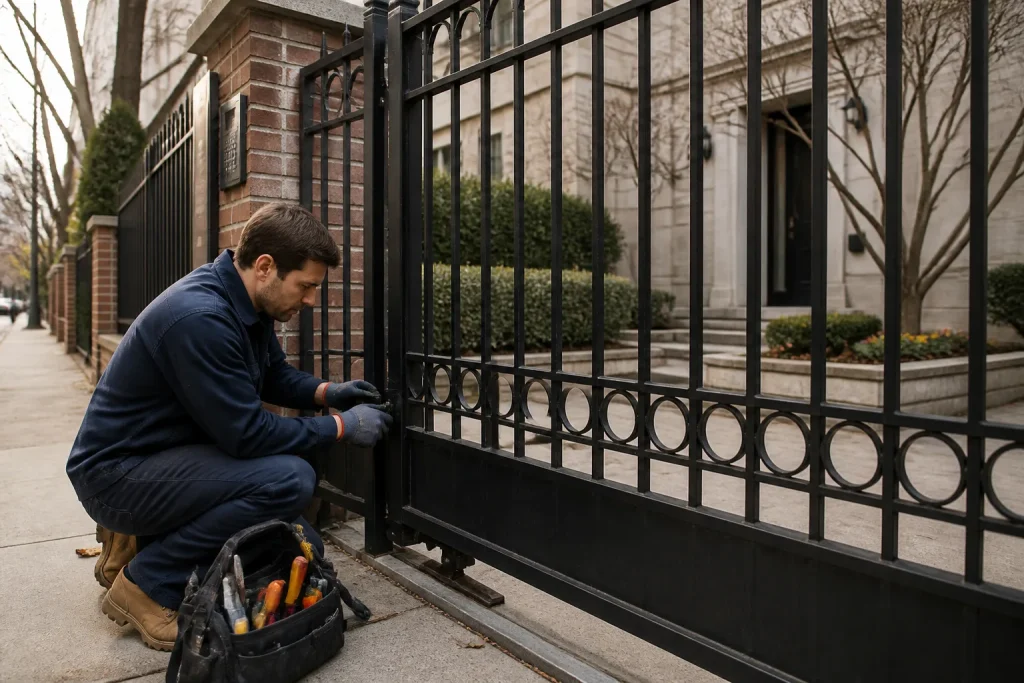
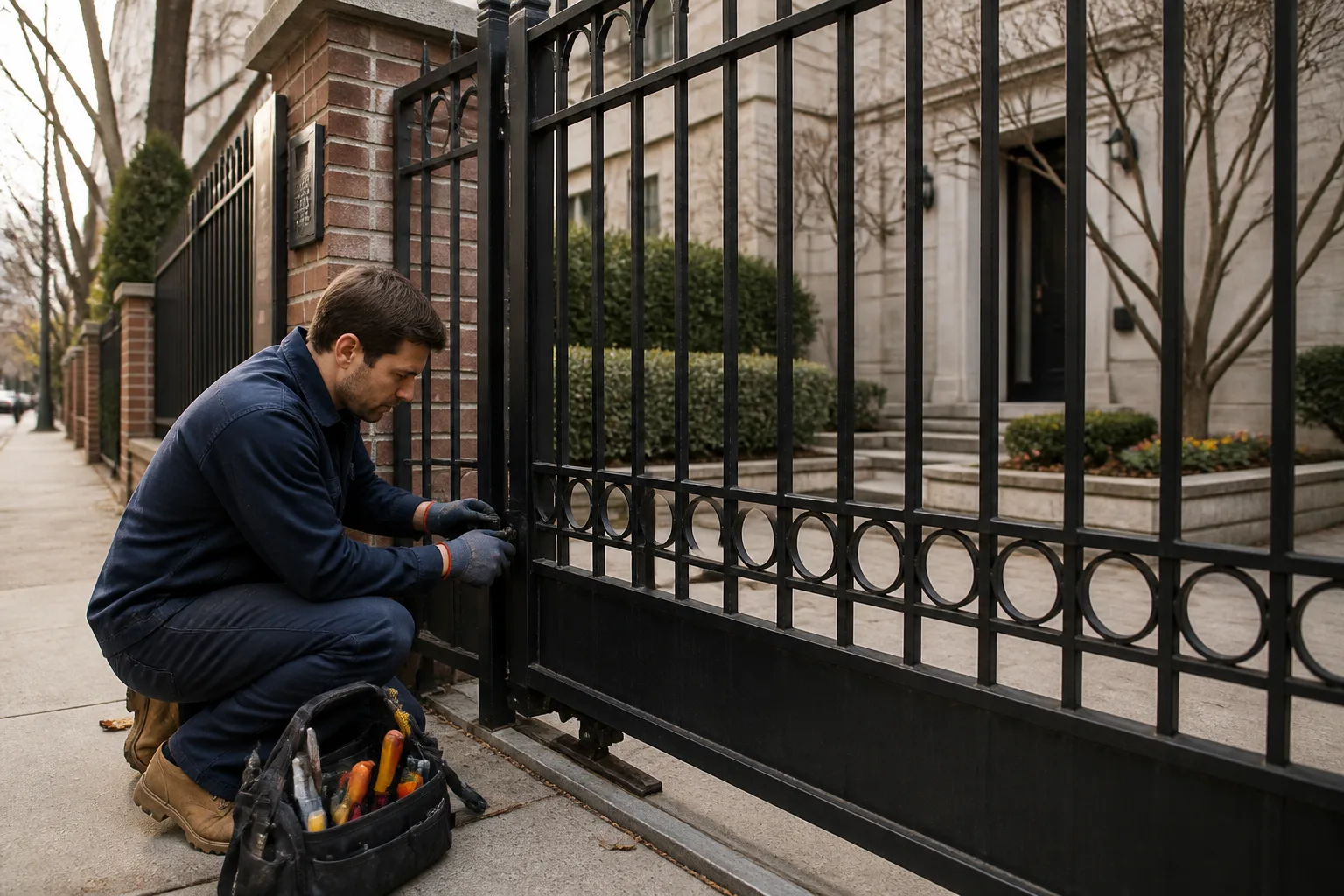
Emergency Gate Repair Near Me: What New York City Homeowners Should Do First
If your driveway gate won’t open or won’t close, the first thing to do is stop touching it. Forcing a gate operator in manual-release mode with the wrong technique is the single most common way a $220 limit-switch repair becomes a $900 motor replacement. The next step is to photograph the failure state from three angles before you move anything, so a technician can diagnose remotely and quote accurately. If you’d rather skip the diagnosis and hand the whole situation to someone who documents everything, call (928) 260-0864.
We pulled a failed FAAC 391 out of a brownstone carport in Park Slope last year where the homeowner had used a pry bar on the release lever because it “felt stuck.” It wasn’t stuck. It was under tension from a partially wound spring, and the pry bar stripped the release mechanism clean off the gearbox. That $180 lever replacement became a $760 motor rebuild, and the guy had photos of nothing because he’d started yanking before he started thinking. This post exists so that doesn’t happen to you.
The Thirty-Minute Window: Why “Emergency” Is a Pricing Category, Not a Service Description
In New York City, the word “emergency” on a gate repair invoice means the technician dropped another job to come to yours at 9 p.m. It does not mean the repair itself is harder, faster, or worth more in parts. You’re paying for availability, and that’s legitimate. What’s not legitimate is when the after-hours labor premium quietly becomes a parts markup too. A good emergency gate company in New York City will charge you a flat after-hours dispatch fee plus the same parts prices they’d charge on a Tuesday afternoon. A bad one will quote you an “emergency package” that includes a motor at 40% above retail and hope you’re too anxious to ask for the part number.
Here’s what an emergency rate should include:
- A clearly stated after-hours labor premium, quoted as a dollar amount before dispatch
- Parts priced at the same rate as non-emergency calls, with part numbers written on the invoice
- A diagnostic fee that’s credited toward the repair if you approve the work
- A written price before any tool touches the gate
Here’s what it shouldn’t include:
- Vague “emergency service” line items that never get itemized
- A technician who can’t tell you the brand of your motor without being on site
- Pressure to replace instead of repair before anyone has opened the housing
- Any resistance to photographing what was found before work begins
The thirty minutes after a gate fails are the window where most New York City homeowners either create a secondary problem or hand a technician a blank check. Knowing the difference between an availability premium and a markup is the whole game.
Step-by-Step Manual Release for the Four Most Common NYC Gate Operators
Most gates in New York City have either a gate motor and opener from LiftMaster, FAAC, BFT, or Viking. Each one has a manual release mechanism, and each one has a specific way it should and should not be operated. The goal of the manual release is to let you move the gate by hand, not to fix the motor. Every time we arrive at a job where the homeowner “tried to release it,” we know we’re going to spend the first fifteen minutes photographing and documenting what happened before we can even diagnose the original failure.
LiftMaster (most common on sliding gates in Queens and Brooklyn)
LiftMaster slide operators have a red release handle on the side of the motor housing. Pull it straight back, slowly, with one hand. The gate should disengage from the drive chain and slide freely. What not to do: don’t pull the handle at an angle, and don’t use a tool to get more leverage. The internal release lever is cast aluminum and shears cleanly when side-loaded. That’s a $140 part, and it’s not covered by any warranty we’ve ever seen.
FAAC (most common on swing gates in brownstone carports and Staten Island driveways)
FAAC swing operators have a release key, usually stored in a plastic sleeve taped to the inside of the operator cover. Insert the key, turn it counterclockwise a quarter turn, and the piston disengages. The gate should swing by hand. What not to do: don’t force a key that won’t turn. A key that resists means the piston is under load from a partially wound spring or an obstruction, and turning harder breaks the key off in the lock. Then you’re paying for the lock extraction before anyone can even look at the original problem.
BFT (common on newer residential installs in Manhattan townhouse mews)
BFT swing and slide operators have a release lever under a small access flap on the bottom of the housing. Push the flap up, find the lever, and pull it down until it clicks. The operator is now disengaged. What not to do: don’t pry the access flap with a screwdriver. The flap is plastic, it’s not designed for leverage, and a cracked flap means water gets into the control board housing. The control board is the most expensive single component in that operator.
Viking (common on commercial-grade residential gates and community entrances)
Viking operators have a release handle on the front face, usually a T-shaped metal pull. Pull it firmly and evenly. The internal clutch releases and the gate moves by hand. What not to do: don’t yank it repeatedly. Every yank cycles the internal release spring, and repeated cycling with no gate movement can bind the mechanism. One firm pull, then stop.
If any of these releases feels wrong, stop. Prop the gate open with a block of wood, lock it in place if you can, photograph the housing and the release mechanism, and call someone who works on that brand. The $220 you save by not breaking the release will cover the diagnostic fee.
How to Document the Failure State Before You Touch Anything
Your phone is the most valuable emergency gate repair tool you own. Before you move the gate, before you pull any release lever, before you even open the operator housing, take photos. We ask every customer to do this, and we do it ourselves on every visit, because a photograph of the failure state answers questions that a verbal description can’t. We operate under a documentation standard where every visit leaves a photo record of what was found, what was set, and what was installed. You should hold yourself to the same standard before the technician even arrives.
Here’s the documentation sequence that helps us diagnose remotely and quote accurately:
- Wide shot of the gate in its failed position. Is it half open? Fully closed? Jammed against the post? This tells us which direction the operator was driving when it failed.
- Close shot of the operator housing. Is the cover cracked? Is there water staining? Is the manual release visibly out of position?
- Close shot of the gate track or hinges. For slide gates, photograph the track where the wheels sit. For swing gates, photograph both hinge plates. An obstruction photos better than it describes.
- Shot of the control board, if you can safely open the housing. Burnt components, blown fuses, and water marks are visible to a technician looking at a photo.
- A 10-second video of you pressing the remote (or keypad) while pointing the camera at the operator. Does the motor hum? Does a light flash? Does nothing happen? That sound and light sequence is diagnostic.
In New York City, where a gate can be fifty feet from the street and buried behind a row of parked cars, this documentation sequence saves everyone a return trip. It also protects you from a technician who arrives, peers at the operator, and names a price without ever opening the housing. If the price isn’t backed by a photo record, you don’t have a price. You have an opening bid.
The Three Questions to Ask Any Emergency Gate Company Before They Arrive
Before you let anyone dispatch a technician to your New York City property at 10 p.m., ask three questions. The answers will tell you whether you’re hiring a gate repair company or a dispatch service that subs out the work to whoever answers the phone.
Question 1: “What brands do you service on emergency calls?” The right answer names specific brands: LiftMaster, FAAC, BFT, Viking, Ghost Controls, DoorKing, and so on. The wrong answer is “all of them.” No technician carries parts for every brand, and a company that says it works on everything usually means it works on nothing particularly well. We service nine gate automation brands, and we’ll tell you which one yours is before we arrive if you read the model number off the housing.
Question 2: “Will you give me a written price before any work starts?” The right answer is yes, flat, no hesitation. The wrong answer is “we’ll see when we get there.” In an emergency, you’re paying for availability, not for the right to be surprised. Our rule is that the price is written and handed over before any tool comes out of the truck. If a company won’t commit to that in writing, before the truck rolls, the emergency is being used as leverage.
Question 3: “What documentation do I get when the work is done?” The right answer is a photo log, a written record of the part number installed, and a warranty in writing. The wrong answer is silence or a shrug. If a technician is proud of the work, they’ll document it. If they’re not documenting it, there’s a reason.
Any company that fails one of these three questions is a company that gets paid to come back and fix the same problem twice. You don’t have time for that at any hour in New York City, let alone during an emergency.
When to Prop the Gate and Wait Versus When to Repair Same-Night
Not every failed gate is an emergency, even in New York City, where street-facing security matters more than it does almost anywhere else. The honest question is whether the gate is a security barrier or a convenience. If it’s a convenience, prop it open and book a daytime appointment. You’ll pay regular labor rates instead of the after-hours premium, and the technician will be working with daylight and a full parts truck.
When it’s safe to prop the gate open and wait:
- The gate failed in the open position and there’s no security-sensitive access point behind it
- The gate is a driveway barrier at a single-family home with a locked front door and no ground-floor windows accessible from the driveway side
- The gate still closes manually and can be secured with a chain and padlock for the night
- The motor failed but the gate itself is undamaged and can be moved by hand once properly released
When same-night repair is genuinely necessary:
- The gate is stuck half open and blocks a public sidewalk or another vehicle
- The failed gate leaves a ground-floor apartment, garage, or side yard directly accessible from the street
- The gate is on a multi-unit building and the trash, delivery, or emergency access route is blocked
- The gate is a pool code barrier and a failed gate means a code violation
In New York City, a gate that fails halfway through its travel on a narrow Queens street can block a fire lane in minutes. That’s a real emergency. A gate that fails in the open position at a single-family home in a quiet Bronx neighborhood can wait until morning. The homeowner who knows the difference saves $300, and the homeowner who doesn’t pays $300 to learn it.
The Bottom Line
An emergency gate repair in New York City is a test of whether you’re dealing with a company that prices in writing or one that prices by the hour and hopes you’re too rattled to ask questions. The thirty minutes after a failure determine what you pay, not just what the technician charges, because the damage you do in a panic is real and itemizable. Photograph the failure state before you touch anything. Know the manual release procedure for your specific operator, and know which mistakes turn a minor part into a major rebuild. Ask the three questions before the truck rolls. And remember: the word “emergency” describes when the technician arrives, not what the parts should cost.
If you’re in New York City and need help, Vance Gate Repair offers free estimates and written pricing before any work starts. Call (928) 260-0864. A live person answers. A written price arrives before the technician does. And the photo record from the job goes home with you, not just into our files.
For more on what we do in New York City, see our Gate Repair in New York City page or our Gate Installation in New York City page. For operator-specific service, visit the Gate Motor & Opener in New York City page. And if you want to know who you’re dealing with before you need us at midnight, start at the Vance Gate Repair home page.
Frequently Asked Questions
Expect an after-hours dispatch premium of roughly $150 to $300 on top of the standard labor rate, depending on the borough and the hour. The actual repair cost depends on what failed: a limit switch runs $120 to $220, a control board replacement runs $400 to $900, and a full motor replacement on a swing gate typically runs $700 to $1,400 parts and labor. The key question is whether the company gives you a written price before any work starts. If they won’t, the emergency rate isn’t a rate, it’s an opening bid. Call (928) 260-0864 for a written estimate before anyone touches your gate.
Yes. A live person answers the phone 24/7 at Vance Gate Repair, and we dispatch technicians on same-night emergency calls across New York City. The after-hours premium is quoted before the truck rolls, and the written price is handed over before any tool comes out of the case. If the situation can wait until morning, we’ll tell you that too, rather than charging you a premium to fix something that isn’t urgent.
Only if you know the specific manual release procedure for your operator, and only if the release operates smoothly on the first try. A forced release on a LiftMaster, FAAC, BFT, or Viking operator can turn a small repair into a major one, and we’ve seen homeowners in New York City do exactly that in under two minutes of panic. If the release feels stuck or resists, stop. Photograph it, prop the gate if you can, and call someone who works on that brand.
You should get a written record of what was found, what was adjusted, and what was installed, with part numbers. At Vance Gate Repair, every visit includes a photo log: the housing before work, the components after adjustment, and the finished repair. That record goes home with you and stays in our job file, so no future technician has to re-diagnose what we already fixed. It’s the same documentation standard we apply to every job, emergency or not.
Written by Adrian Vance, Owner at Vance Gate Repair, serving New York City since 2014.
Need Gate Repair Help?
Call Vance Gate Repair - licensed & insured, here with fast after-hours help in Dallas.
(928) 260-0864