
FAAC Gate Repair in New York City: A Homeowner’s Guide
FAAC gate repair in New York City usually comes down to three parts failing in a predictable order: the capacitor, the encoder, then the control board. Roughly 70% of FAAC units sent back under warranty as “motor failures” test fine on the bench. The actual culprit is a capacitor that costs about $18. If your FAAC gate stopped moving, you should read the blink code before you approve any repair estimate. If you’d rather not deal with it yourself, call (928) 260-0864 and we’ll walk you through it.
The FAAC Fault-Code Sequence: Read the Lights Before You Call Anyone
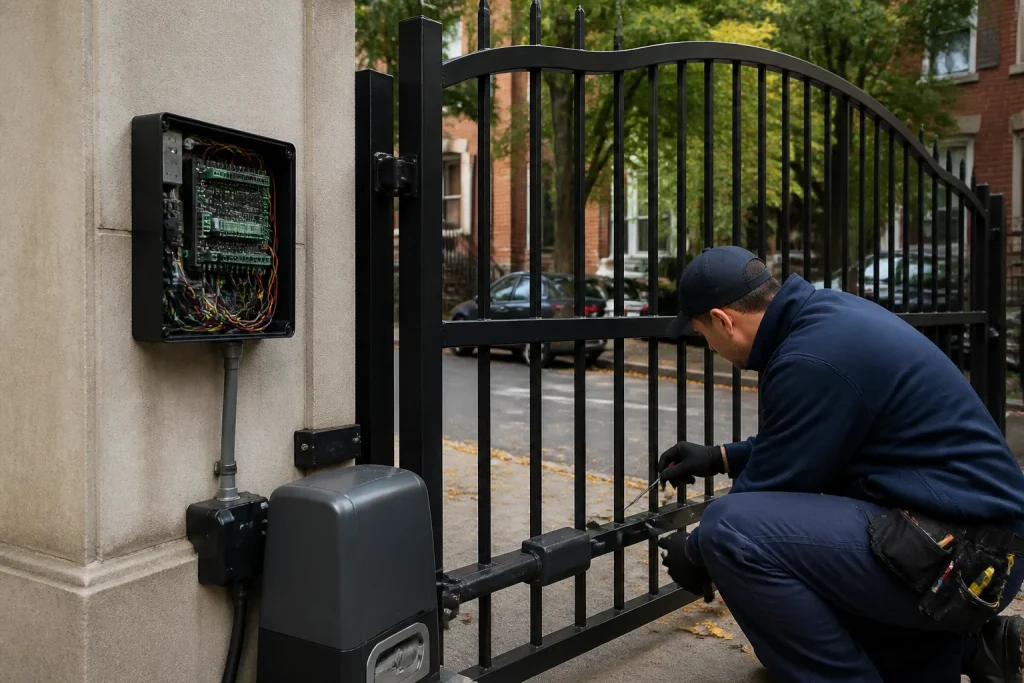
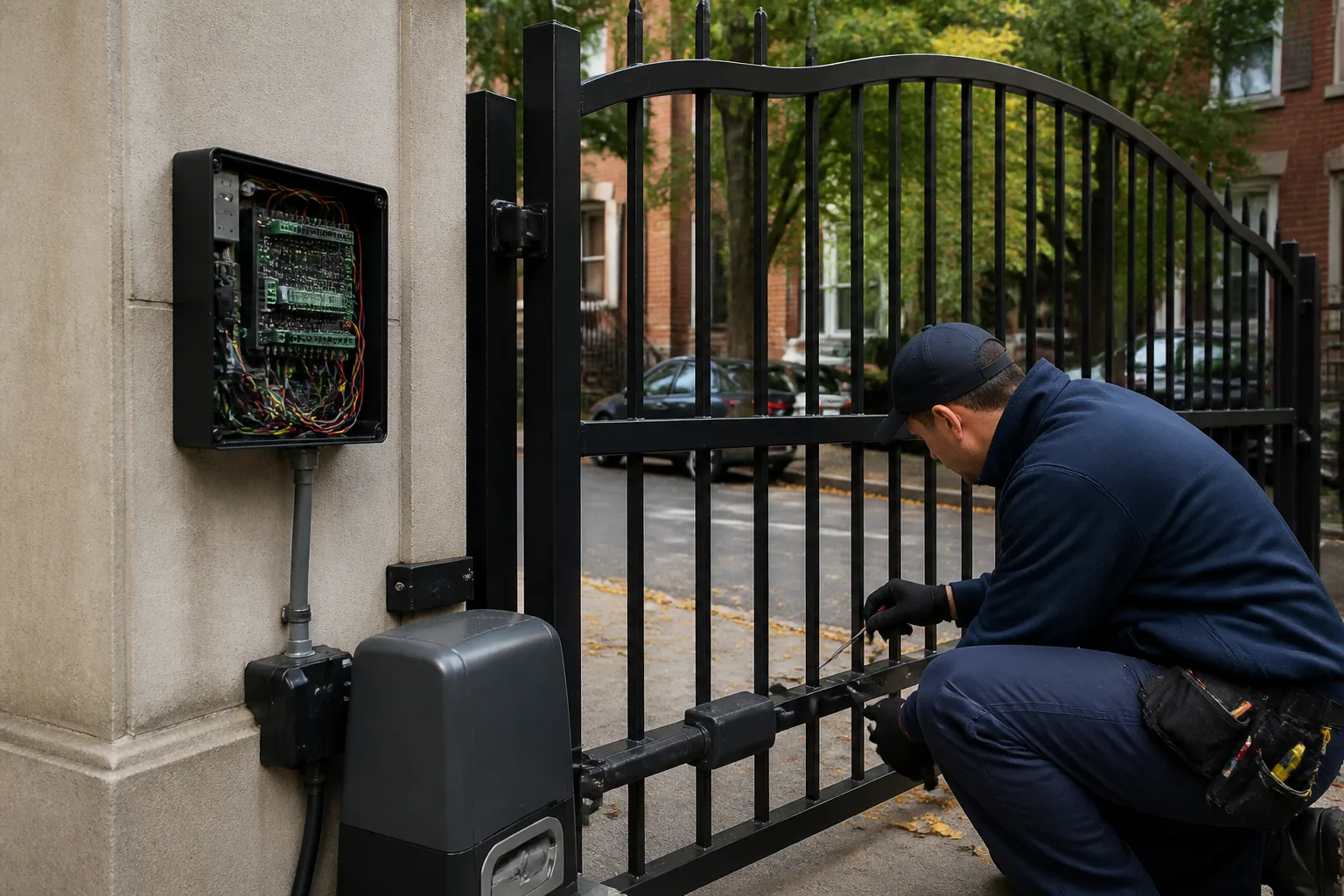
FAAC builds its diagnostic logic into a series of LED flashes on the control board. Most homeowners in New York City never look at this. Most technicians in New York City do, but plenty skip the full protocol because it takes time. The result is a parts cannon: replace the board, replace the motor, swap the capacitor last if the gate still won’t run.
On a 400 or 500 series operator, a single flash usually points to a photocell obstruction. Two flashes mean the motor capacitor is out of tolerance. Three flashes indicate a limit-switch or encoder problem. The exact pattern depends on the board revision, which is stamped on the board itself, and the FAAC service manual for that revision lists every code in sequence at the back of the manual. We photograph that blinking pattern and log it on every FAAC visit under Clause 4 of our Haven Standard: evidence on every job.
Here’s the order you check things in:
- Capacitor first. It is the cheapest component and the most common actual fault. A bulged or leaked capacitor is visible before you touch a meter.
- Encoder second. If the gate starts to open and then reverses or stalls mid-travel, the encoder is giving the board bad position data. That is not a motor failure.
- Control board third. Boards do fail, especially after a close lightning strike or a power surge off a New York City utility line. But they fail less often than the parts listed above them.
This is not the order most people want to hear, because the board is the expensive fix and everyone assumes the worst. We have pulled FAAC boards out of units in Forest Hills that were fine. The real problem was a capacitor that had been slowly dying for a year before the gate quit entirely.
What NYC Salt Air and Freeze-Thaw Actually Do to a FAAC Unit
FAAC publishes a default service interval of two years for hydraulic fluid changes. That interval assumes a clean, moderate environment. New York City is not that environment. The salt air that blows off the East River and the Atlantic does not stay on the road. It finds its way into condensation, into connector pins, into the breather port on the hydraulic reservoir. Over one winter season, that moisture is enough to start the slow degradation of the fluid inside the operator.
And then it freezes. When water works its way into a connector, it expands as ice, cracks the plastic housing or pushes a pin loose. Come spring, the gate moves sluggishly. The pump whines. The homeowner in Queens or Staten Island thinks the motor is worn out. The actual fault is contaminated hydraulic fluid and a connector that has been wicking moisture since December.
What this means practically is you should shorten the FAAC service interval if your gate sits near the water or in an area that gets heavy salting in winter. Change the fluid every 18 months, inspect the breather and the pigtail connectors every fall, and look for green or white residue around the connector pins. That residue is the early warning sign, and it shows up on FAAC units near the Hudson River in Manhattan and on the harbor side of Staten Island far sooner than FAAC’s manual predicts.
The Three Parts Replaced Unnecessarily on Urban FAAC Operators
We see the same pattern in New York City driveways year after year. A gate stops working. A technician arrives, spends 20 minutes looking at it, and pronounces the motor dead. The quote goes up. The homeowner pays. The gate runs for six months. Then the same problem comes back, because the motor was never the problem on day one.
The three parts most frequently swapped out without being the root cause:
- The capacitor. When a capacitor dies, the motor will not start under load. A technician who does not test it will call the motor failed and sell a $900 replacement when an $18 part was the fix.
- The encoder. The encoder tells the control board where the gate is in its travel. A dirty encoder reads wrong. A technician who skips cleaning and testing will swap the encoder for $300 when a clean and recalibration would restore it.
- The control board. Boards get replaced after a low-voltage or power event when the board simply needs its limit settings relearned. That is a 15-minute procedure documented in the FAAC manual, not a $400 board swap.
Every one of these is avoidable with a diagnostic sequence. Under our Haven Standard Clause 3 (No unnecessary work, no unnecessary parts), we do not replace a part until the tested evidence says it failed. We would rather hand a New York City homeowner a photograph and a clean bill of health than a bill for a board their gate did not need. And if you already have a written estimate from another company saying the motor is dead, bring it in. We review other companies’ written estimates for free.
What a Legitimate FAAC Repair Record Should Include
The difference between a good FAAC repair and an expensive guess is the paper trail. Most gate work in New York City leaves no trail at all. The technician arrives with no part numbers, makes a verbal diagnosis, and drives off with no documentation. When the same unit fails again, the next guy starts from zero. The homeowner pays twice to rediscover the same problem.
A real FAAC repair record should list, at minimum:
- The fault code that was present on arrival, with the board revision number it came from.
- Every part that was swapped, with the FAAC part number and the serial number off the old part where readable.
- The limit-switch settings left behind: travel limits, slowdown points, and any torque adjustment values.
- Photographs of the board before work, the failed component, and the new part installed.
That’s the standard we work to on every FAAC job in New York City, and it’s the same standard Vance Gate Repair home was built on. Adrian Vance started documenting commercial access-control jobs in 2014, and the habit carried over into residential gate work. If a FAAC technician cannot produce a fault code or a part number, what you are getting is an opinion, not a repair. You have a right to better evidence than that.
Genuine FAAC Parts vs. Generic Substitutes: Why It Matters for Your 2-Year Warranty
FAAC components carry a two-year warranty when you use genuine FAAC parts. Generic substitutes carry whatever the supplier feels like honoring, and that is usually nothing. The issue in New York City is that generic parts are widely stocked and cheap, and a technician under price pressure will use them without telling you.
How to verify you are getting genuine FAAC: ask for the part number before the work is done, then call FAAC’s parts line and confirm the number. Genuine FAAC parts ship in FAAC packaging with a hologram label and a serialized QA sticker. The part number is etched or printed on the component itself, not just on the box. If the part shows up loose in a plastic bag with no FAAC marking, it is a substitute.
The reason this matters is not brand snobbery. Counterfeit or generic motor capacitors fail early. Generic encoders do not hold calibration the way the FAAC-spec parts do, especially in the damp air coming off the New York City waterfront. And if a generic part fails once, it usually damages the part beside it the second time. A $50 generic capacitor can eat a $300 control board on its way out. We service nine automation brands, including FAAC, LiftMaster, BFT, Linear, Viking, Ghost Controls, DoorKing, Elite, and Mighty Mule, so we order from each brand’s authorized parts line rather than whatever is at the local supply counter. That is how you protect the warranty. It is also how you keep a gate running past the first winter.
When to Call a Pro Instead of Working on a FAAC Operator Yourself
A FAAC operator is not a do-it-yourself project for the same reason a breaker panel is not: there are components under load inside that carry enough current to hurt you, and the gate leaf itself weighs several hundred pounds. The capacitor holds a charge even after the power is off. A moving gate that loses its limits can crush a hand or pin a child. This is the safety caveat we give every homeowner before they open the cover of an operator: if you are not confident with a multimeter and you cannot find the breaker, call someone who is.
What you can check safely: the breakers, the obstructions in the track, the photo-eye alignment (the small infrared beam that stops the gate when something crosses it), and whether the manual release is engaged. That last one causes more New York City service calls than any other single cause. If the gate moves freely by hand but will not move under power, check the release before you call. We have driven to brownstones in Brooklyn for that exact diagnosis. Still, if you have checked all of the above and the gate will not move, the problem is electrical or hydraulic, and it belongs in front of a trained technician with the right test equipment.
Related services in New York City: we handle Gate Repair in New York City, Gate Installation in New York City, and Gate Motor & Opener in New York City with the same written-pricing standard on every job.
The Bottom Line
FAAC operators in New York City fail in a sequence: capacitor, encoder, board. If you learn to read the blink code and insist on a written fault-code diagnosis before any part gets ordered, you will not pay for a motor that was never the problem. Cut the service interval if you are near the salt air. Verify genuine FAAC part numbers. And demand a written record of what was found and what was left behind. The companies that do not document their work are the ones that charge you twice for the same repair.
If you’re in New York City and need FAAC work done, Vance Gate Repair offers free estimates and a written price before any work starts. Call (928) 260-0864 and a live person will answer. We’ll ask what the gate is doing, walk you through the blink code over the phone, and if we come out, we’ll photograph everything we do.
Frequently Asked Questions
Most FAAC repairs in New York City run between $180 and $450 for parts and labor when the fault is a capacitor, a limit switch, or a photo-eye. A control board replacement usually falls between $500 and $900 installed. The exact price depends on your board revision and what the fault code shows, and you should get it in writing before anyone starts. Call (928) 260-0864 for an exact quote on your unit, free.
Yes, in most cases. If the fault is a capacitor or a photo-eye, the part fits in a service van and the repair takes under two hours on site. Control board replacements can take a day or two if your board revision is not stocked locally, though we keep most common FAAC revisions on hand. Call (928) 260-0864 and tell us the blink pattern, and we will give you a realistic window before we even dispatch.
FAAC warrants genuine components for two years from installation. The warranty covers manufacturing defects in the part itself. It does not cover damage caused by incorrect installation, contaminate hydraulic fluid, or a power surge. The warranty stays valid when you use genuine FAAC parts and keep a record of the part numbers installed. If you have a prior repair with no written record, the warranty is difficult to enforce.
Ask three questions before you approve anything: What is the fault code on arrival? What part number are you replacing? What limit-switch settings will you leave behind? A good FAAC tech answers all three without pausing. If they cannot produce a fault code, they are guessing. If they will not give you a part number, you are probably getting a generic substitute. If they will not document the settings, the next repair starts from zero, which means you pay for the same diagnosis twice.
Written by Adrian Vance, Owner at Vance Gate Repair, serving New York City since 2014.
Need Gate Repair Help?
Call Vance Gate Repair - licensed & insured, here with fast after-hours help in Dallas.
(928) 260-0864